
The Psychology Behind Overchoice and What It Does to Your Brain
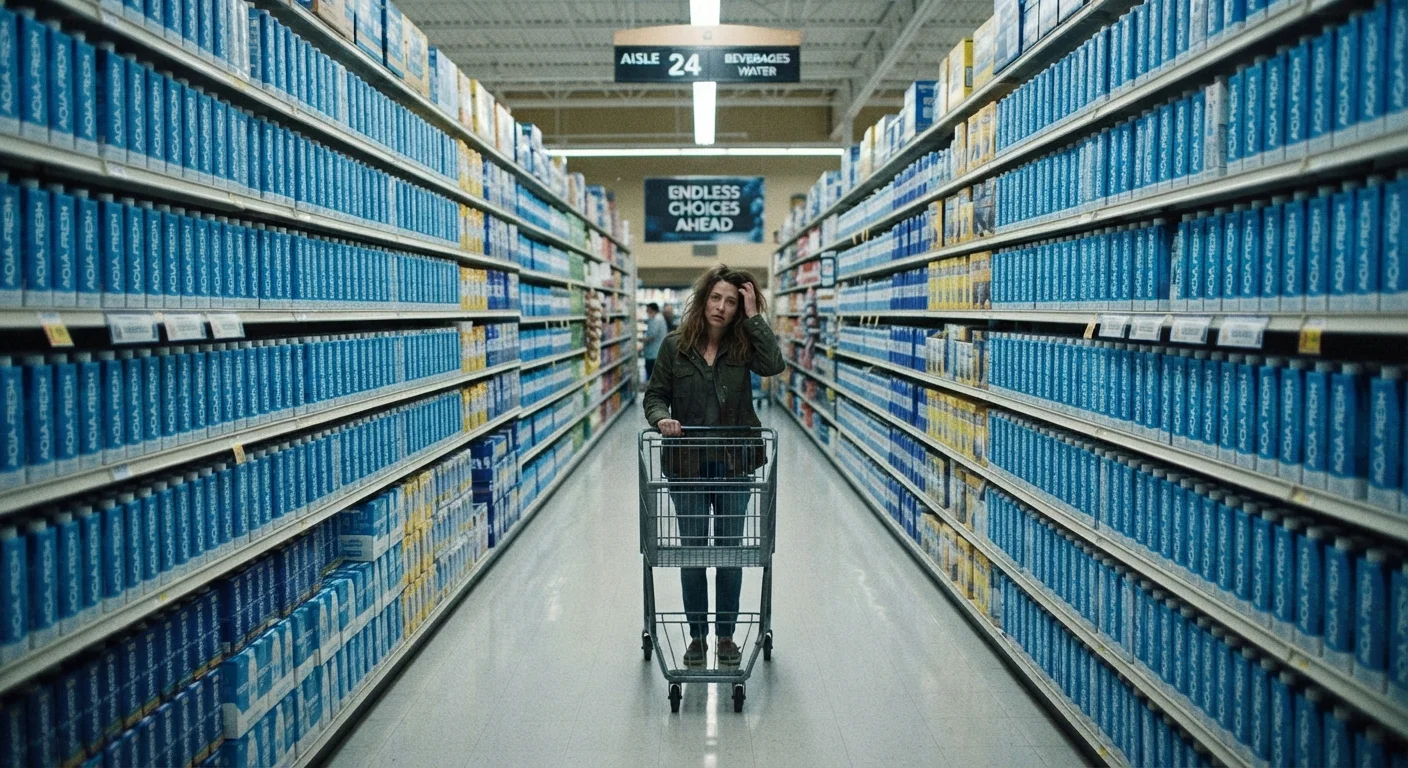
Photo credit: SnippetColumns.com | Easy Search, Reliable Information
In this article
Overchoice isn't just frustrating — it triggers measurable stress responses. Explore the science of too many options and how your brain tries to cope.
Key Takeaways
- More options reliably increase stress and reduce decision confidence, according to established behavioral research.
- The brain treats large option sets as a threat, triggering measurable cognitive load and mild stress responses.
- Overchoice often results in decision avoidance — shoppers walk away without buying at all.
- Satisfaction with a chosen product typically drops when more alternatives were available during selection.
- Simple mental frameworks can interrupt the overchoice cycle before it drains your energy.
Where the Science Begins
In 2000, psychologists Sheena Iyengar and Mark Lepper published a study that became a cornerstone of consumer psychology. Shoppers at a grocery store were shown either 6 varieties of jam or 24. The larger display attracted more browsers — but the smaller display generated roughly ten times the purchase rate. The study illustrated a counterintuitive truth: abundance can suppress action rather than enable it.
This finding has been replicated across categories including retirement fund enrollment, speed-dating choices, and online product searches. The pattern holds: after a threshold — researchers estimate roughly 7 to 10 meaningful options — additional choices reliably increase cognitive load without increasing decision quality.
10x
Purchase rate with fewer options
In Iyengar and Lepper's grocery store study, shoppers shown 6 jam varieties were approximately 10 times more likely to buy than those shown 24.
~7–10
Options before cognitive overload sets in
Consumer psychology research suggests decision quality begins declining reliably once meaningful options exceed roughly 7 to 10 alternatives.
68%
Workers who struggle with workplace information overload
A survey by information management researchers found that a substantial majority of knowledge workers report that excessive options and data impair their decision-making at work.
Understanding why this happens requires a quick look at how the brain handles comparison tasks.
What Happens Inside the Brain
When you evaluate options, the prefrontal cortex — the region responsible for planning, comparison, and impulse regulation — does the heavy lifting. Each additional option requires the brain to model, compare, and store another data point. This is metabolically expensive work.
As the option set grows, the brain faces a math problem it cannot efficiently solve. Rather than linear processing, it attempts to run parallel comparisons, which rapidly depletes working memory. The result feels like mental fog: a difficulty concentrating, a sense of mild dread, and an urge to postpone the decision entirely. Researchers describe this as increased cognitive load — the total mental effort demanded at any given moment.
Crucially, this load triggers a mild stress response. Cortisol — the body's primary stress hormone — rises modestly when cognitive demand outpaces available mental resources. That stress response is adaptive in dangerous environments, but in a shopping context, it simply makes decisions feel higher-stakes than they are. The tendency to push through that stress rather than stepping back often deepens the paralysis.
The Opportunity Cost Problem
One underappreciated driver of overchoice distress is opportunity cost — the value of what you give up by choosing something. When only two options exist, forgoing one alternative is a straightforward calculation. When 40 options exist, choosing any single item means mentally setting aside 39 others.
Psychologist Barry Schwartz, in his research on what he called the "paradox of choice," argued that this expanded opportunity cost is a major source of post-decision regret. Maximizers — people who feel compelled to find the objectively best option — suffer most, because they cannot rationally evaluate every alternative, yet feel responsible for doing so.
“The secret to happiness is low expectations. Maximizers make the best decisions of anyone — and feel the worst about them.”
— Barry Schwartz, Professor Emeritus of Psychology, Swarthmore College; author of 'The Paradox of Choice'
This explains why satisfaction with a product often drops after choosing from a large set, even when the chosen item is perfectly good. The brain has already primed itself to expect a compromise. That expectation colors the experience.
For a deeper look at how this feeds into broader shopping exhaustion, the cognitive mechanics of decision fatigue are worth understanding alongside overchoice.
Breaking the Cycle Before It Costs You
Overchoice is a structural problem — product categories genuinely contain more options than they did a generation ago. But the cognitive response to it is manageable once you recognize the pattern.
The most effective documented strategies work by reducing the active option set before deliberation begins. Pre-committing to two or three hard criteria — budget ceiling, one must-have feature, one deal-breaker — eliminates the majority of alternatives without requiring direct comparison. Behavioral researchers call this "elimination by aspects," and it consistently reduces both decision time and post-decision regret.
Set Your Criteria Before You Browse
Write down your two or three non-negotiable requirements before opening a product category — maximum price, a specific feature, a minimum rating threshold. Anything that doesn't meet all three criteria gets eliminated immediately, without further evaluation. This reframes shopping as a filtering task rather than a comparison marathon, which is far less cognitively taxing.
A second strategy is satisficing: choosing the first option that meets your minimum threshold rather than searching for an optimum. It feels like settling, but the research suggests satisfaction outcomes are comparable — and the cognitive cost is dramatically lower.
Detailed frameworks for applying these approaches in real shopping situations are covered in mental frameworks that cut through product overwhelm. And if you find yourself perpetually delaying a decision rather than making it, the hidden cost of keeping options open too long outlines why prolonged indecision has its own real costs.
Overchoice isn't a character flaw or a sign of indecisiveness. It's a predictable neurological response to an environment that has outpaced the brain's native comparison capacity. Recognizing it as a system problem — not a personal one — is the first step toward spending smarter.
Frequently Asked Questions

Author
Smart Shopping Editorial Team
Smart Shopping Editorial Team is the collective byline for our editorial team and contributor network. Articles published under this byline or an editorial pen name are researched, written, and reviewed according to our editorial standards for clarity, consistency, and independence before publication.
View all articles →