
Cash Envelopes vs. Digital Budgeting Apps: Two Approaches to Spending Control
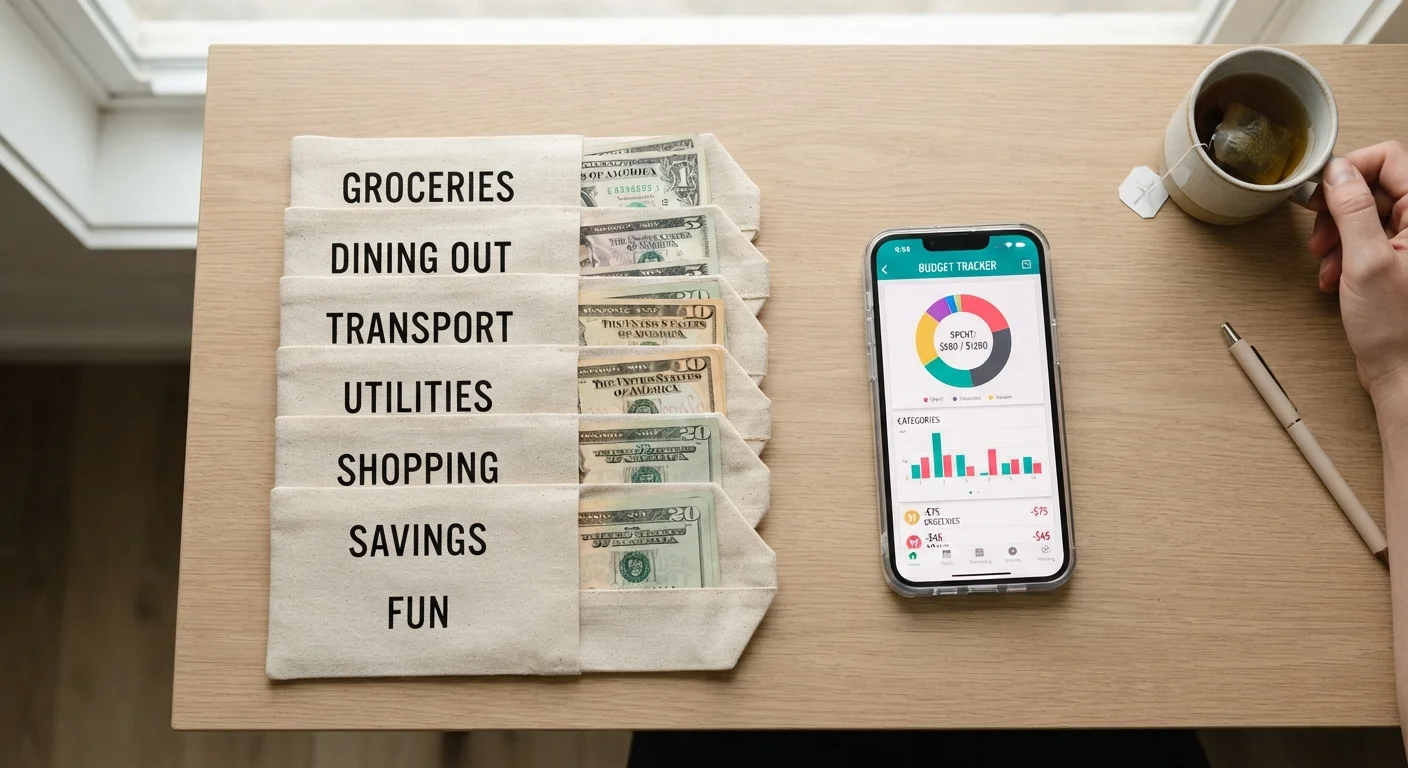
Photo credit: SnippetColumns.com | Easy Search, Reliable Information
In this article
A side-by-side look at analog envelope budgeting and app-based tracking to help you find what fits your lifestyle.
Key Takeaways
- Cash envelopes create hard spending limits that physically prevent overspending in each category.
- Digital apps offer convenience, automation, and multi-account visibility that cash cannot match.
- The cash method works best for variable spending categories like groceries and dining out.
- Apps excel for people who rarely use cash and need to track card transactions across accounts.
- Neither method requires perfection — consistency matters more than the tool itself.
- Some people combine both strategies, using envelopes for problem categories and apps for overall tracking.
How Each Method Actually Works
Cash envelope budgeting is straightforward: at the start of each pay period, you withdraw physical cash and distribute it into labeled envelopes — one per spending category. Groceries, dining out, gas, entertainment. When an envelope is empty, spending in that category is done until the next cycle. There's no app to configure, no account to link, and no algorithm to trust. It's a direct, tactile system built around the simple reality that you can't spend money you don't have in hand.
Digital budgeting apps work differently. You connect your bank accounts, credit cards, and sometimes investment accounts to a single dashboard. Transactions are pulled in automatically and sorted into categories. You set spending limits per category, and the app tracks your progress in real time. Some apps send alerts when you're close to a limit; others generate monthly reports showing trends over time. The experience is convenient and data-rich — but it depends on you actually reviewing the numbers regularly.
For a broader look at how these two philosophies line up in practice, see our comparison of envelope budgeting and digital spending trackers.
| Criterion | Cash Envelopes | Digital Budgeting Apps |
|---|---|---|
| Setup effort | Low — envelopes and cash only | Moderate — account linking required |
| Spending categories covered | Variable/discretionary spending | All spending, fixed and variable |
| Overspend prevention | Hard stop — cash runs out | Alert-based, easy to override |
| Works with card payments | No | Yes — automatic sync |
| Spending reports and history | Manual tracking only | Automated categorized reports |
| Cost | Free | Free to paid subscription tiers |
| Best for | Impulse spenders, beginners | Multi-account, data-driven users |
Where Each Method Has the Edge
Cash envelopes have one advantage that no app can replicate: the pain of paying. Research in behavioral economics consistently finds that parting with physical cash feels more significant than swiping a card, which can reduce impulse spending. When someone sees their dining envelope thinning out mid-month, the visual cue is immediate and hard to rationalize away. For variable spending categories — the ones most people struggle to control — that friction is genuinely useful.
Digital apps, on the other hand, handle complexity that cash simply can't. Rent, utilities, subscriptions, and automatic transfers don't fit neatly into envelopes. Apps track everything across accounts, flag recurring charges, and often identify subscriptions you may have forgotten. If your financial life involves multiple cards, accounts, or irregular income, a well-configured app provides visibility that a manila envelope cannot.
~33%
Americans with a detailed monthly budget
Gallup polling has consistently found that fewer than one-third of U.S. adults maintain a detailed household budget, highlighting how common budget avoidance is regardless of income.
18%
More spent with cards vs. cash
Multiple consumer behavior studies have found that people tend to spend meaningfully more when paying by card compared to cash, due to reduced psychological friction at the point of purchase.
The honest trade-off: envelopes require a trip to the ATM, handling physical money, and manually restocking each cycle. Apps require discipline to actually review what they're tracking — automation can create a false sense of control if you're not checking in regularly. Both systems fail the same way: through neglect, not design.
Whichever method you choose, pairing it with consistent tracking habits strengthens the outcome. Our guide on spending tracking methods that work in daily life covers complementary habits worth building alongside either approach.
Choosing What Fits — or Combining Both
The best budgeting system is the one you'll actually use. If you've tried apps and found yourself ignoring notifications, or if you tend to rationalize card spending after the fact, a physical envelope system for your problem categories may be more effective — even if it feels old-fashioned. Conversely, if you almost never use cash and your spending is split across three cards and two bank accounts, asking yourself to manage all of that with envelopes creates unnecessary friction.
Many people land on a hybrid approach: they use a digital app for overall budget awareness and fixed expenses, while keeping cash envelopes for one or two high-risk categories like dining or discretionary spending. This captures the psychological brake of cash where it's most needed, without sacrificing the convenience of digital tracking everywhere else.
No Method Works Without Review
Both cash envelopes and digital apps require one non-negotiable habit: regularly checking in on where you stand. Envelopes need to be restocked intentionally each cycle; apps need to be opened and reviewed — not just trusted to run quietly in the background. Building a short weekly or biweekly money check-in, even just five to ten minutes, dramatically improves results with either system. See our piece on mindful vs. autopilot spending for more on building that habit.
Budgeting method aside, the underlying habit that matters most is awareness — knowing where your money goes before it's gone. Whether that awareness comes from a labeled envelope or a pie chart on your phone is secondary. If you're exploring other frameworks for building that discipline, our overview of the pay-yourself-first budgeting approach is a practical next read. You can also explore more everyday strategies in our Budgeting Basics hub.
This article is for general informational and educational purposes only and does not constitute personalized financial advice. Consult a qualified financial professional for guidance tailored to your individual circumstances.

Author
Money & Finance Editorial Team
Money & Finance Editorial Team is the collective byline for our editorial team and contributor network. Articles published under this byline or an editorial pen name are researched, written, and reviewed according to our editorial standards for clarity, consistency, and independence before publication.
View all articles →