
Short-Term vs. Long-Term Savings Goals: Matching Your Strategy to Your Timeline
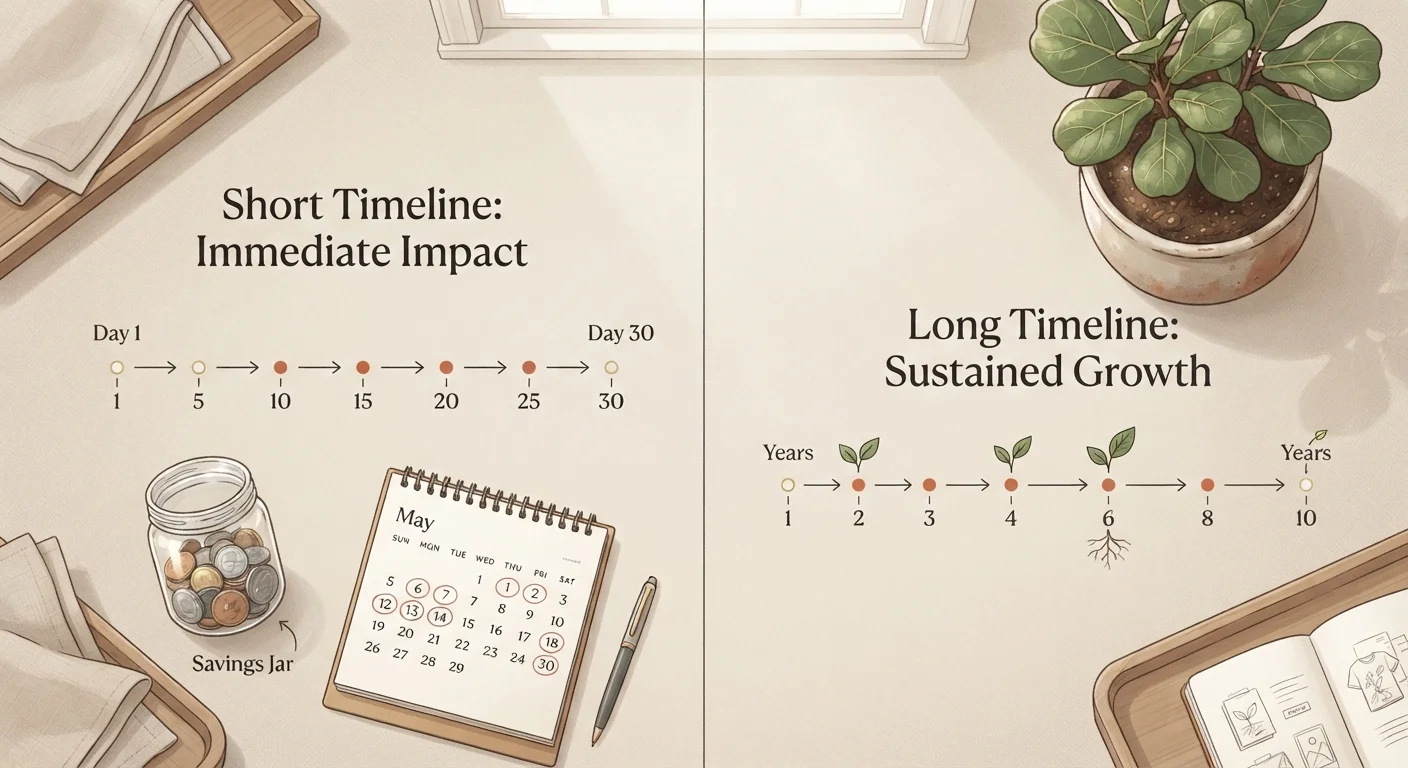
Photo credit: SnippetColumns.com | Easy Search, Reliable Information
In this article
The approach that works for a vacation fund rarely works for a decade-away goal. Understand how timeline should shape your savings decisions.
Key Takeaways
- Short-term goals prioritize liquidity and stability; long-term goals can tolerate more risk for potential growth.
- Timeline is the single most important factor in choosing where and how to save.
- Mixing short- and long-term money in the same account often leads to unintentional spending or missed growth.
- Inflation erodes purchasing power, making low-yield accounts risky for long-horizon goals.
- Consulting a licensed financial adviser is recommended before making investment decisions for long-term goals.
Why Timeline Changes Everything
Most people think about savings goals in terms of the dollar amount they need. That's understandable — a $5,000 vacation fund feels different from a $50,000 down payment. But the more consequential variable is time. How long until you need the money determines where it should live, how it should be managed, and how much risk is appropriate along the way.
A short-term goal generally means you'll need the funds within one to three years. A long-term goal sits five or more years out, with some — like retirement — stretching decades into the future. Goals in between, say three to five years out, sit in a middle zone that requires careful judgment about stability versus growth.
The reason timeline matters so much comes down to two forces: liquidity (how quickly you can access your money without penalty) and volatility risk (how much value a savings vehicle can temporarily lose). Short-term savers can't afford to lose value right before they need the funds. Long-term savers, on the other hand, can let short-term fluctuations ride out — which opens the door to vehicles with higher growth potential. For a deeper look at the full savings landscape, see our end-to-end savings and goal-setting resource.
Short-Term Goals: Stability First
When the deadline is close, capital preservation takes priority. The core question for a short-term savings account isn't "How much could this grow?" — it's "Will this money definitely be here when I need it?"
Common vehicles for short-term goals include high-yield savings accounts, money market accounts, and short-duration certificates of deposit (CDs). These options generally keep your principal intact and offer predictable, if modest, returns. They also tend to be FDIC-insured up to applicable limits, which adds a layer of protection.
What short-term vehicles trade off is growth potential. In a low-to-moderate interest rate environment, returns may barely keep pace with inflation — but that's an acceptable trade when the alternative is exposing money you need in 18 months to a market correction.
Don't Let Accounts Blur Together
Keeping short-term and long-term savings in separate, clearly labeled accounts isn't just organizational — it's protective. When everything pools together, it becomes harder to track progress toward individual goals and easier to justify dipping into funds meant for a distant milestone. Many banks allow you to create named sub-accounts or buckets within a single savings account, which can help without requiring multiple bank relationships.
One practical trap: mixing short-term savings with long-term investments in the same account. When the money feels abstract and distant, it's easier to spend. Keeping accounts separated — with clear labels for each goal — creates a psychological and logistical barrier against raiding a goal-specific fund. See how to structure multiple savings goals simultaneously for practical structures.
For more on specific fund types like emergency funds and sinking funds, understanding the difference between them matters when deciding where each dollar belongs.
Long-Term Goals: Growth Potential and Patience
A goal that's a decade or more away looks very different in terms of strategy. Because you have time on your side, the compounding effect of growth-oriented vehicles becomes meaningful — and the short-term price fluctuations that would destroy a near-term goal become less relevant.
Long-term savers often explore investment accounts — including tax-advantaged options designed specifically for retirement or education — where money has the potential to grow substantially over time. However, these accounts involve market exposure and carry risk. Returns are not guaranteed, and past performance of any investment does not predict future results. Anyone considering this path should consult a licensed financial adviser to understand what's appropriate for their situation.
| Criterion | Short-Term Goals | Long-Term Goals |
|---|---|---|
| Typical timeline | Under 3 years | 5+ years |
| Primary priority | Capital preservation | Growth potential |
| Risk tolerance | Very low | Moderate to higher |
| Liquidity needs | High — funds needed soon | Low — money can stay put |
| Inflation sensitivity | Lower concern short-term | Major concern over decades |
| Common vehicles | High-yield savings, CDs | Investment accounts, tax-advantaged plans |
| Professional guidance needed | Often manageable independently | Strongly recommended |
Inflation is the underappreciated enemy of long-term savers who stick entirely to cash-equivalent accounts. A dollar saved today may buy significantly less in 20 years if it earns only modest interest. That's why, for very long horizons, holding all savings in ultra-conservative vehicles carries its own form of risk — purchasing-power erosion. The goal isn't to take unnecessary risk; it's to take calibrated risk appropriate to the timeline and your individual circumstances.
A framework for translating a distant goal into concrete monthly targets can help make long-term saving feel actionable. See this step-by-step goal-setting framework for a structured approach.
Putting It Into Practice
Applying timeline logic to your actual goals doesn't require a financial overhaul. Start by listing every savings goal you're working toward — or planning to — and assign each one a realistic deadline. Then sort them into short-term (under three years), medium-term (three to five years), and long-term (five-plus years) buckets.
From there, match each bucket to an appropriate savings vehicle: stability-focused accounts for the near-term bucket, and progressively growth-oriented options (with professional guidance) for longer horizons. This separation keeps your strategy aligned with each goal's actual requirements rather than applying one-size-fits-all logic.
3–6 months
Recommended short-term emergency fund size
Financial planning guidelines generally suggest keeping three to six months of essential expenses in a liquid, stable account before aggressively funding longer-term goals.
~3%
Average historical U.S. inflation rate
The U.S. Bureau of Labor Statistics historical data shows long-run consumer price inflation averaging around 3%, underscoring the purchasing-power risk of keeping long-horizon money in low-yield cash accounts.
It's also worth reviewing your plan periodically. Life changes — income shifts, goals get added, timelines move. A savings checkup is a useful habit for catching drift before it becomes a meaningful gap. And if you're not yet saving automatically before your paycheck gets spent, the pay-yourself-first approach is worth understanding as a structural method for making savings consistent.
This article is for general informational and educational purposes only. It does not constitute personalised financial, investment, tax, or legal advice. Consult a qualified, licensed financial professional before making decisions about your savings or investment strategy.

Author
Money & Finance Editorial Team
Money & Finance Editorial Team is the collective byline for our editorial team and contributor network. Articles published under this byline or an editorial pen name are researched, written, and reviewed according to our editorial standards for clarity, consistency, and independence before publication.
View all articles →