
Smart Thermostat vs. Programmable Thermostat: Understanding the Real Difference
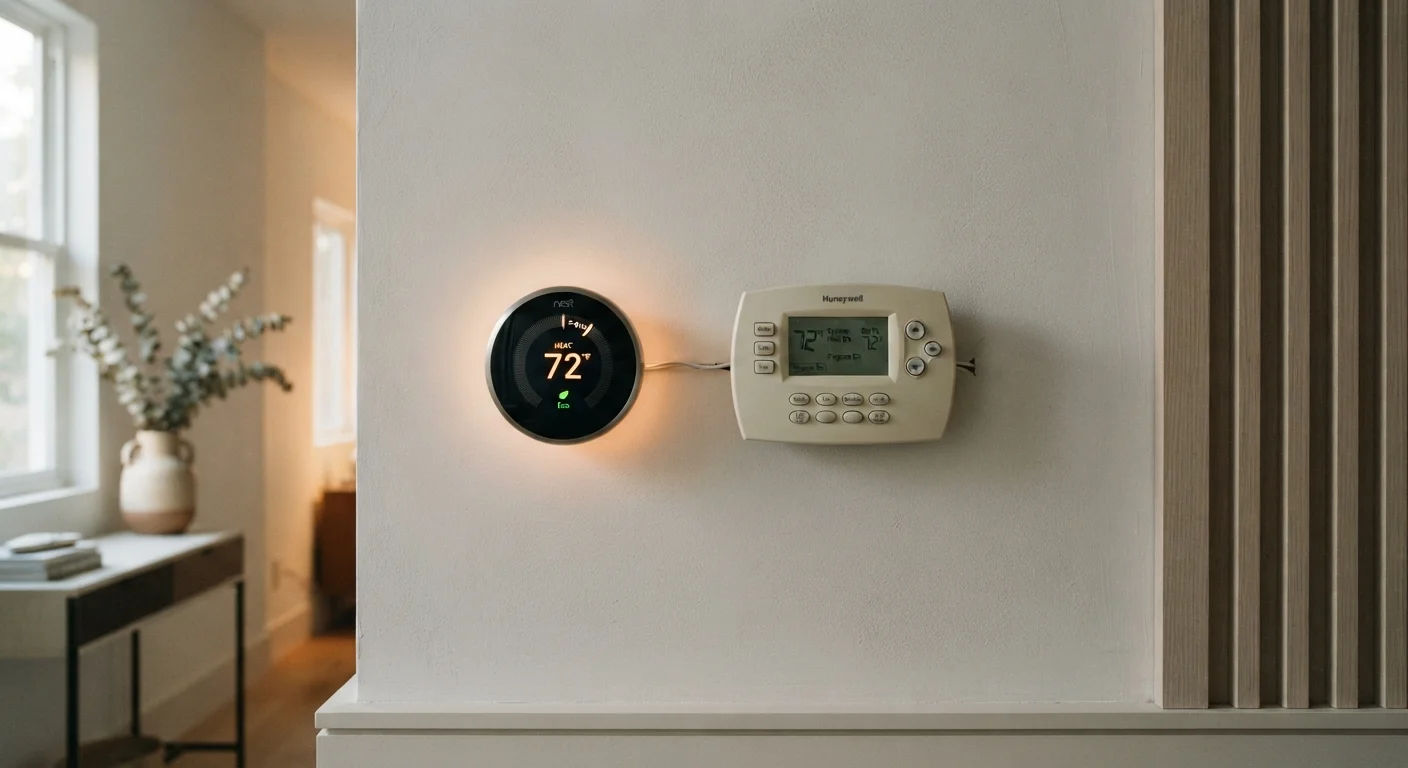
Photo credit: SnippetColumns.com | Easy Search, Reliable Information
In this article
Both save energy in theory — but they work in very different ways. Here's a clear breakdown to help you understand which approach suits your household.
Key Takeaways
- Programmable thermostats follow fixed schedules you set manually; smart thermostats can adapt those schedules automatically.
- Smart thermostats typically require Wi-Fi and a smartphone app to unlock their full feature set.
- Either type can reduce energy use compared to a manual thermostat — but only if configured and used correctly.
- Smart thermostats generally cost more upfront, though some utility programs offer rebates (check with your provider).
- Your home's wiring and HVAC system compatibility matters before choosing either option.
How Each Type Actually Works
The core difference comes down to how decisions get made. A programmable thermostat follows instructions you've already given it — you enter a schedule (say, 68°F on weekdays from 7 a.m. to 9 p.m.), and it executes that plan every day without deviation. It has no awareness of whether you're home, whether your schedule shifted, or what the weather's doing outside.
A smart thermostat can do everything a programmable one does, but it layerson top of that a set of capabilities driven by connectivity and, in some cases, machine learning. It can receive updates from your phone's location, adjust based on occupancy sensors, respond to utility grid signals, and in some models, learn from your manual adjustments over time to build a schedule automatically.
To understand where these devices fit in the broader picture of home technology, see what makes a home truly smart — the distinction between "connected" and "smart" is meaningful here.
| Criterion | Smart Thermostat | Programmable Thermostat |
|---|---|---|
| Scheduling | Automated or adaptive learning | Manual, user-defined schedules |
| Remote control | Yes, via smartphone app | No remote access |
| Internet required | Yes for full functionality | No |
| Occupancy awareness | Often yes (sensors or geofencing) | No |
| Energy usage reports | Typically included | Not available |
| Typical upfront cost | Higher | Lower |
| Setup complexity | Moderate (app + account setup) | Low (manual programming) |
| Works without Wi-Fi | Partially (basic control only) | Fully |
Energy Savings: The Reality Behind the Promise
Both types are marketed as energy-saving tools, and both can be — but neither delivers savings automatically. A programmable thermostat only helps if you actually program it thoughtfully and stick to the schedule. Studies have found that many households either never customize the default program or override it manually so often that the efficiency benefit disappears.
Smart thermostats have an edge in theory: they can adapt when your real behavior doesn't match a preset schedule. If you leave work early or stay away an extra day, a smart thermostat with location awareness adjusts; a programmable one doesn't. That responsiveness is where the energy argument in favor of smart models is strongest.
~8%
Estimated heating cost reduction per degree setback
The U.S. Department of Energy has indicated that turning your thermostat back 7–10°F for 8 hours a day can save roughly 8% on heating and cooling costs annually.
40%+
Share of home energy use from heating and cooling
According to the U.S. Energy Information Administration, space heating and cooling together represent the largest single portion of residential energy consumption.
That said, neither type is a guaranteed energy cure-all. Factors like your home's insulation, HVAC efficiency, and local climate have far greater impact on overall energy use. Both thermostats are tools — their value depends on how well they're set up and used. For context on how automation works more broadly as a household efficiency strategy, the concept maps well to how automated systems work and their trade-offs.
Installation, Compatibility, and What to Check First
Before choosing either type, check your existing wiring. Most programmable thermostats work with standard two- to five-wire HVAC setups. Smart thermostats often require a C-wire (common wire) to provide continuous power for Wi-Fi and display functions — not all older homes have one. Some smart thermostat models include workarounds or adapter kits, but compatibility isn't universal.
Check Your Wiring Before You Buy
The C-wire (common wire) provides continuous 24V power and is required by most smart thermostats. If your current system doesn't have one, some models offer adapter solutions, but these add complexity. Before purchasing, check your current thermostat's wiring label or consult your HVAC system's documentation. When in doubt, a licensed HVAC technician can assess compatibility quickly.
If you're new to thinking about smart home upgrades in general, it's worth reading through what to think through before your first smart home device — ecosystem compatibility and privacy considerations apply here just as much as with any connected device. You can also explore how thermostats fit into the full landscape of smart home device categories to see how they interact with other systems in your home.

Author
Tech & Gadgets Editorial Team
Tech & Gadgets Editorial Team is the collective byline for our editorial team and contributor network. Articles published under this byline or an editorial pen name are researched, written, and reviewed according to our editorial standards for clarity, consistency, and independence before publication.
View all articles →