
Reading Your Auto Insurance Declarations Page Without Getting Lost
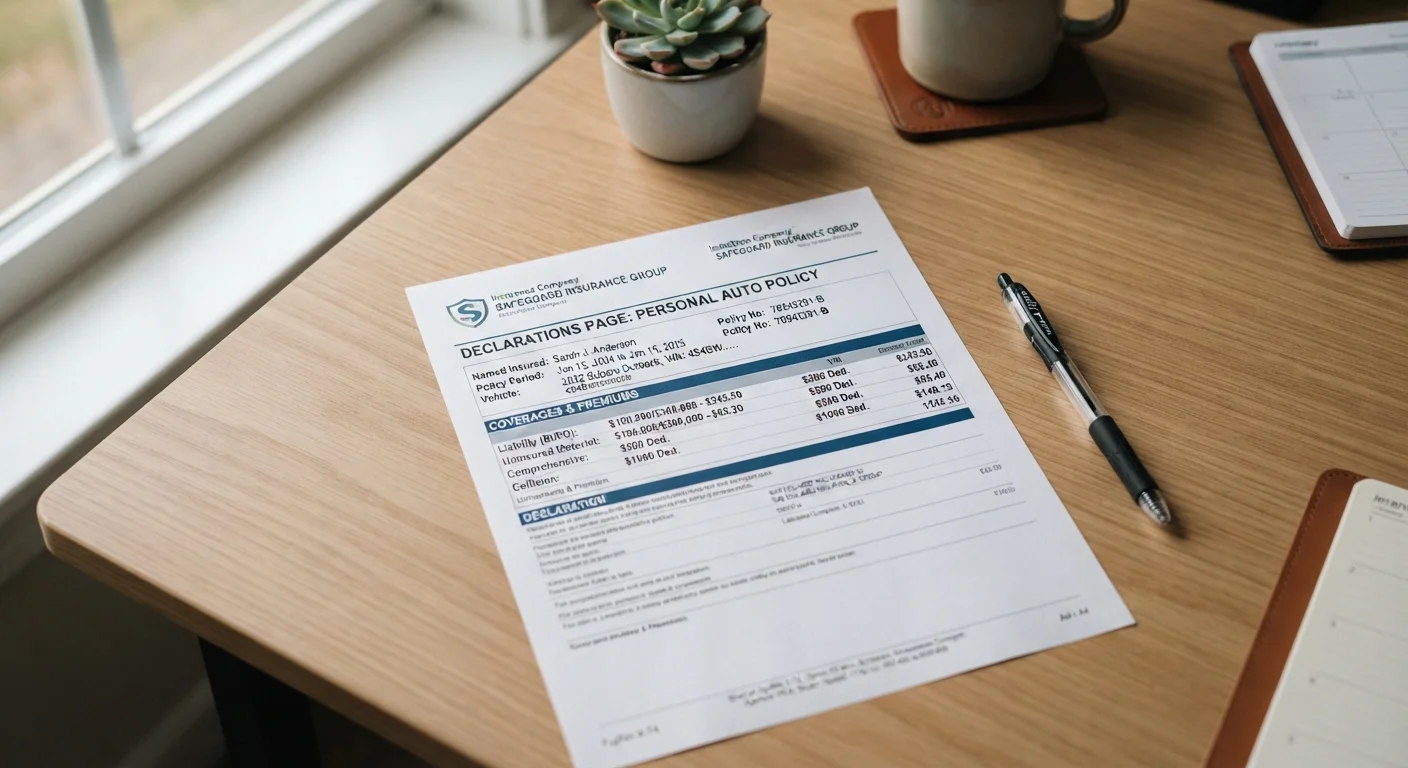
Photo credit: SnippetColumns.com | Easy Search, Reliable Information
In this article
Your declarations page is the most important sheet in your policy. Here's how to find every key number and what it tells you.
Key Takeaways
- The declarations page is a one- or two-page summary of your entire auto insurance policy.
- It lists your named insured, covered vehicles, policy period, coverage types, limits, and deductibles.
- Coverage limits are written as split limits (e.g., 100/300/100) or as a single combined single limit.
- Your deductible is the out-of-pocket amount you pay before insurance covers the rest of a claim.
- Misreading your limits or missing a listed driver can leave you underinsured without realizing it.
- Review your declarations page every renewal period to confirm it reflects your current situation.
What the Declarations Page Actually Is
Insurance policies are dense legal documents that can run dozens of pages. The declarations page - often called the "dec page" - sits at the front and summarizes everything that matters most: who is covered, what vehicles are on the policy, what coverage you carry, and how much protection you actually have. Think of it as the receipt for your policy.
Most insurers issue a new declarations page each time your policy renews, typically every six or twelve months. When you need to verify coverage quickly - at a dealership, after an accident, or while shopping for a new policy - this is the page you reach for. If you need a refresher on what each coverage type actually does, the coverage explainer breaks each one down in plain language.
What you will need
How to Read Every Section, Step by Step
Follow these steps to work through your declarations page methodically. Grab your current dec page - digital or paper - before you begin.
Confirm the named insured and policy period
At the very top of the dec page you'll find the named insured - the person(s) legally covered as the primary policyholder - along with the policy number and the policy period (the start and end dates of your coverage). Verify your name is spelled correctly and the dates are current. An expired policy period means you may be driving without active coverage.
Identify the covered vehicles
Below the policyholder information you'll see a vehicle schedule listing each car on the policy by year, make, model, and VIN (Vehicle Identification Number). Check that every vehicle you own and intend to insure appears here, and that the VINs match your registration documents. A vehicle not listed is generally not covered.
Read your coverage types and limits
This is the core of the dec page. Each coverage type is listed alongside its limit - the maximum your insurer will pay. Liability limits are often written in split-limit format such as 100/300/100, which means $100,000 per person for bodily injury, $300,000 per accident for bodily injury, and $100,000 for property damage. Some policies use a combined single limit (CSL), one lump-sum figure that applies across all liability claims in an accident.
Other coverages you may see listed include collision, comprehensive, uninsured/underinsured motorist, medical payments (MedPay), and personal injury protection (PIP). For a plain-language explanation of each, see the auto insurance glossary.
Locate your deductibles
Your deductible is the amount you pay out of pocket before your insurer pays the rest on a covered claim. Deductibles typically apply to collision and comprehensive coverage. They appear as a dollar figure next to each coverage line - commonly $250, $500, or $1,000. A higher deductible lowers your premium but increases what you owe after a claim.
Check listed drivers and endorsements
Many dec pages include a driver schedule listing everyone rated on the policy. Confirm all regular household drivers are included. Also scan for any endorsements - policy add-ons or modifications that expand or restrict standard coverage (such as roadside assistance, rental reimbursement, or an exclusion for a specific driver). Endorsements can significantly change what you're protected against, and they're easy to miss if you only skim the limits section.
Store a Digital Copy for Easy Access
Download your declarations page as a PDF and save it to a cloud folder or your phone's files app. You'll be able to pull it up instantly after an accident or when a lender asks for proof of coverage - no digging through glove compartments required.
Common Mistakes and What to Do Next
Two errors appear repeatedly when drivers review their dec pages. First, assuming that listed limits are adequate without comparing them to your actual assets - state minimums are often far lower than what a serious accident could cost you. Second, not verifying that every driver in your household is listed. An unlisted regular driver can create coverage complications when a claim arises.
State Minimums Are a Floor, Not a Standard
Every state sets minimum liability coverage requirements, but those floors are often far below what a serious accident actually costs. If your dec page shows only your state's minimum limits, you may be underinsured. Review whether your limits adequately protect your financial situation, and speak with a licensed insurance agent if you're unsure what level of coverage makes sense for you.
Once you understand your current policy, you may find changes are warranted. Moving, adding a vehicle, or welcoming a new driver to your household are all events that should trigger a policy review. See how to keep your policy current as your circumstances evolve. For a full end-to-end picture of how auto insurance works, the comprehensive auto insurance overview covers premiums, state minimums, and claims in one place.
This article is for general informational purposes only and does not constitute personalized insurance, financial, or legal advice. Coverage terms, limits, exclusions, and regulations vary by insurer and by state. Always read your actual policy documents and consult a licensed insurance agent or adviser for guidance specific to your situation.

Author
Autos & Driving Editorial Team
Autos & Driving Editorial Team is the collective byline for our editorial team and contributor network. Articles published under this byline or an editorial pen name are researched, written, and reviewed according to our editorial standards for clarity, consistency, and independence before publication.
View all articles →