
Natural Sugars vs. Added Sugars: Why the Distinction Matters
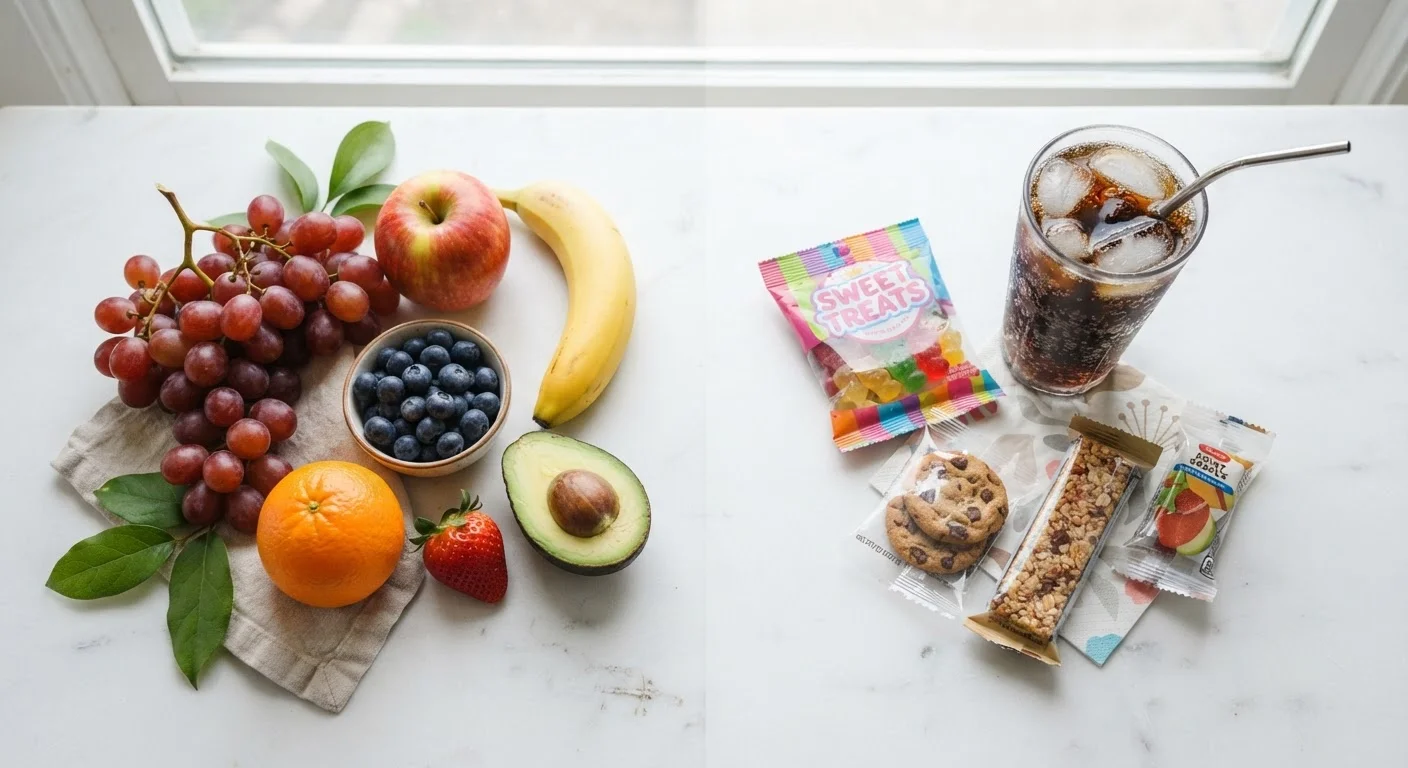
Photo credit: SnippetColumns.com | Easy Search, Reliable Information
In this article
The sugar in an apple and the sugar in a soda aren't treated the same by nutrition guidelines. Here's the science behind the difference.
Key Takeaways
- Natural sugars come packaged with fiber and nutrients; added sugars arrive alone, delivering calories without nutritional support.
- The 2020–2025 Dietary Guidelines for Americans recommend limiting added sugars to less than 10% of total daily calories.
- Nutrition labels now must list added sugars separately, making it easier to track intake at a glance.
- Whole fruit is not equivalent to fruit juice — processing removes fiber that moderates sugar absorption.
- Cutting added sugars is one of the most broadly supported dietary changes in mainstream nutrition science.
What Makes a Sugar 'Natural' or 'Added'?
The terms natural sugars and added sugars describe origin, not chemistry. At a molecular level, the fructose in a strawberry and the fructose in a flavored yogurt are identical. The meaningful difference lies in the food matrix surrounding them.
Natural sugars occur intact within whole foods. The lactose in plain milk and the fructose in an apple come bundled with fiber, protein, water, vitamins, and minerals. These surrounding components slow digestion and moderate the rate at which sugar enters the bloodstream.
Added sugars, by contrast, are sugars and syrups that manufacturers — or home cooks — introduce during processing or preparation. They include table sugar (sucrose), high-fructose corn syrup, honey added to packaged granola, and dozens of other sweetening agents. When added to a product, they bring calories but none of the nutritional co-passengers found in whole food sources. For a broader look at how labeling communicates this distinction, see how to read a nutrition label.
| Criterion | Natural Sugars | Added Sugars |
|---|---|---|
| Origin | Occur intact in whole foods | Introduced during processing or cooking |
| Examples | Fructose in fruit, lactose in milk | Cane sugar, high-fructose corn syrup, honey in packaged foods |
| Accompanying nutrients | Fiber, vitamins, minerals, water | None — calories only |
| Absorption rate | Moderated by fiber and food matrix | Typically faster; limited buffering |
| Dietary guideline limits | No specific cap for whole food sources | Under 10% of daily calories (U.S. guidelines) |
| Listed separately on label | No | Yes — required under updated U.S. rules |
Why Nutrition Guidelines Target Added Sugars Specifically
The 2020–2025 Dietary Guidelines for Americans advise keeping added sugar intake below 10% of total daily calories. No equivalent cap applies to natural sugars found in whole fruits, vegetables, or dairy. That asymmetry is deliberate and evidence-informed.
When sugar arrives stripped of fiber and other nutrients — as it does in sweetened beverages, candy, and many baked goods — it is absorbed more rapidly and contributes to excess caloric intake without increasing satiety. A substantial body of research links high added sugar consumption to increased risk of weight gain, type 2 diabetes, cardiovascular disease, and dental decay. These associations are far weaker or absent for naturally occurring sugars consumed within whole foods.
17 tsp
Average daily added sugar intake for U.S. adults
According to CDC data, U.S. adults consume roughly 17 teaspoons of added sugar daily — well above the recommended ceiling of about 12 teaspoons for a 2,000-calorie diet.
~49%
Share of added sugar from beverages
The CDC estimates that nearly half of all added sugar consumed by Americans comes from sweetened drinks, including soft drinks, energy drinks, and fruit-flavored beverages.
10%
Recommended added sugar ceiling (% of daily calories)
The 2020–2025 Dietary Guidelines for Americans set 10% of total daily calories as the upper limit for added sugar intake across all age groups.
It is worth noting that whole fruit is not nutritionally equivalent to fruit juice, even 100% juice. Juicing removes or significantly reduces the fiber that moderates sugar absorption, shifting naturally occurring fructose closer in behavior to added sugar. The line between whole and processed foods is often blurrier than it first appears, and fruit juice is a clear example of that complexity.
How to Spot Added Sugars on a Label
Revised U.S. nutrition label regulations now require food manufacturers to list added sugars as a separate line beneath total sugars. This change makes it substantially easier to distinguish a product like plain Greek yogurt — whose sugar is naturally occurring lactose — from a flavored version with tablespoons of added sweetener.
Added sugars can appear under more than 60 names in ingredient lists, including: cane juice, brown rice syrup, maltose, dextrose, agave nectar, and corn syrup solids. If any sweetening agent appears high in the ingredient list, the product is likely a significant source of added sugar regardless of how it is marketed.
A useful heuristic: the closer a food is to its original whole-food form, the less likely it contains meaningful added sugars. Plain oats, unseasoned beans, fresh produce, and unflavored dairy are reliable low-added-sugar choices. For more on separating food label facts from marketing noise, common nutrition myths offers useful context.
This article is for general informational and educational purposes only and does not constitute medical or dietary advice. Consult a qualified healthcare professional or registered dietitian for guidance tailored to your individual health needs.

Author
Health & Wellness Editorial Team
Health & Wellness Editorial Team is the collective byline for our editorial team and contributor network. Articles published under this byline or an editorial pen name are researched, written, and reviewed according to our editorial standards for clarity, consistency, and independence before publication.
View all articles →