
Secondhand vs. Fast Fashion: Weighing the Real Trade-Offs
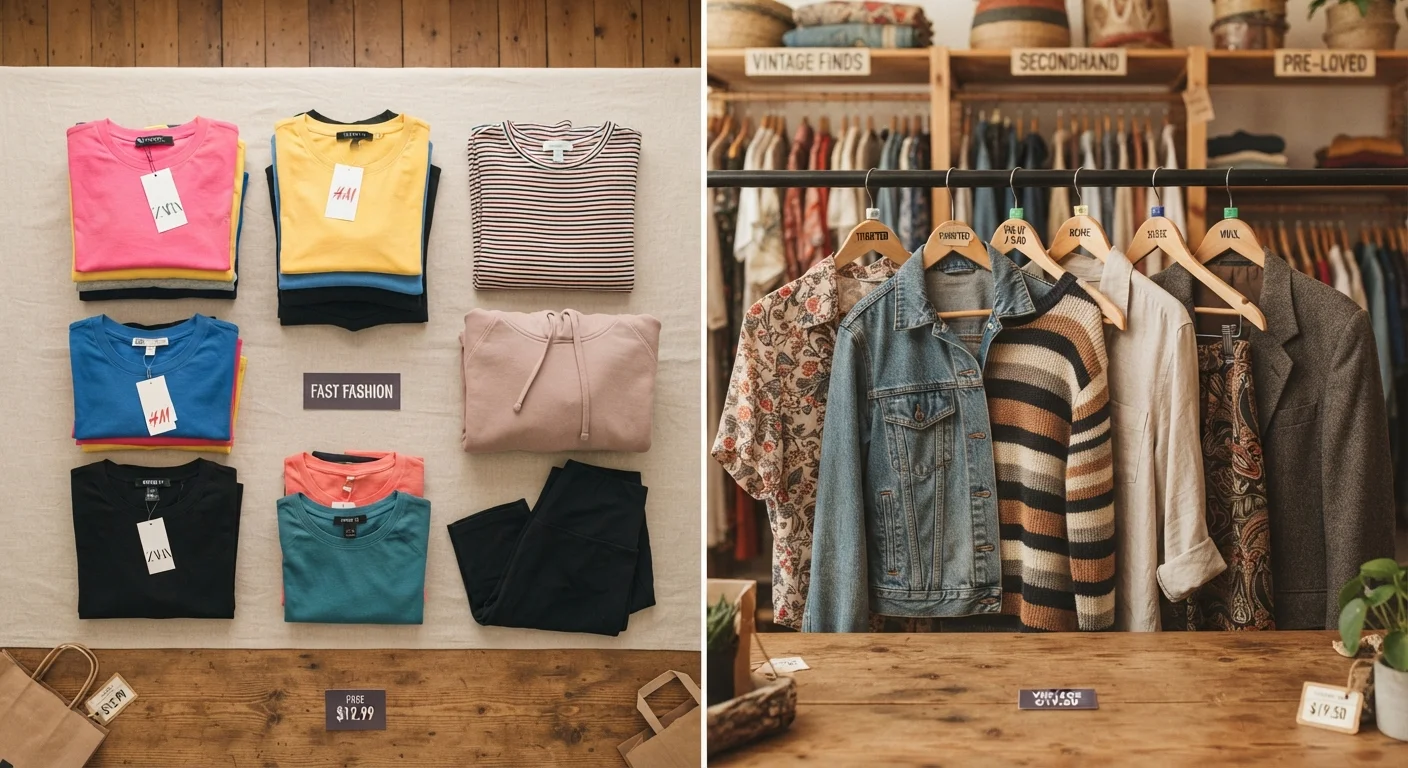
Photo credit: SnippetColumns.com | Easy Search, Reliable Information
In this article
Thrifting and fast fashion each come with genuine advantages and drawbacks. This balanced comparison helps you decide what fits your life and budget.
Key Takeaways
- Fast fashion offers convenience and low upfront cost but often sacrifices garment durability.
- Secondhand shopping can save money and reduce waste, but requires more time and effort to find the right pieces.
- Neither approach is perfect — a hybrid strategy works best for most budgets and lifestyles.
- Fabric quality matters regardless of where you shop; knowing what to look for protects your investment.
- Environmental and ethical considerations are real but complex in both categories.
Lower upfront cost at fast fashion retailers
Fast fashion makes clothing accessible for tight budgets, with many basic pieces available at prices that don't require careful deliberation. This matters when you need something specific quickly and can't afford to wait for the right thrift find.
Secondhand offers better value on quality garments
Well-made blazers, denim, and outerwear from earlier decades often appear on secondhand racks at a fraction of their original price. Shoppers willing to search can find garments with stronger construction than anything available new at a similar price point.
Fast fashion delivers size consistency and predictability
Buying new means standardized sizing, consistent availability, and easy returns — a meaningful convenience advantage over secondhand, where inventory is entirely unpredictable.
Secondhand shopping extends garment lifespan
Every secondhand purchase keeps a garment in use longer, which has a measurable environmental benefit compared to producing a new item. This is one of the more straightforward sustainability arguments in favor of thrifting.
Variety and one-of-a-kind finds in secondhand
Thrift and consignment stores often carry garments that simply aren't available in current retail — distinct silhouettes, better fabric weights, and styles that don't appear in today's mass-market cycle.
Fast fashion garments often wear out quickly
Lower-cost construction and synthetic blends mean many fast fashion pieces lose their shape or finish after limited use. The true cost per wear can exceed what it initially appears when you factor in replacement frequency.
Secondhand shopping is time-intensive
Finding the right piece in the right size and condition requires repeated visits or extensive online browsing. For shoppers with limited time, this friction is a genuine barrier that fast fashion simply doesn't present.
Fast fashion's environmental footprint is substantial
High-volume production, synthetic materials, and rapid trend cycles contribute to significant textile waste and resource use. These costs are diffuse and not reflected in the retail price.
Condition and hygiene uncertainty in secondhand
Pre-owned garments vary widely in condition, and online listings don't always accurately represent wear or damage. Buyers need to know what to inspect and factor in potential cleaning or repair costs.
Secondhand pricing has risen on popular platforms
As resale has grown in mainstream popularity, prices on platforms like Poshmark and Depop have increased — particularly for trending styles or recognizable labels, which can undercut the value proposition.
What We're Actually Comparing
The debate between secondhand and fast fashion is often framed as a moral one — but for most everyday Americans, it's a practical question. Can you find what you need, at a price that works, without wasting time or money on clothing that falls apart?
Fast fashion refers to mass-produced clothing designed for rapid turnover, typically sold at low price points with trend-driven styles. Secondhand shopping — whether through thrift stores, consignment shops, or resale platforms — means buying pre-owned garments, often at a fraction of their original retail price.
Both have real advantages and genuine drawbacks. Understanding those trade-offs helps you make choices that reflect your actual priorities, not just marketing pressure. For a broader look at how to stretch your clothing budget, see Wardrobe on a Budget.
Lower upfront cost at fast fashion retailers
Fast fashion makes clothing accessible for tight budgets, with many basic pieces available at prices that don't require careful deliberation. This matters when you need something specific quickly and can't afford to wait for the right thrift find.
Secondhand offers better value on quality garments
Well-made blazers, denim, and outerwear from earlier decades often appear on secondhand racks at a fraction of their original price. Shoppers willing to search can find garments with stronger construction than anything available new at a similar price point.
Fast fashion delivers size consistency and predictability
Buying new means standardized sizing, consistent availability, and easy returns — a meaningful convenience advantage over secondhand, where inventory is entirely unpredictable.
Secondhand shopping extends garment lifespan
Every secondhand purchase keeps a garment in use longer, which has a measurable environmental benefit compared to producing a new item. This is one of the more straightforward sustainability arguments in favor of thrifting.
Variety and one-of-a-kind finds in secondhand
Thrift and consignment stores often carry garments that simply aren't available in current retail — distinct silhouettes, better fabric weights, and styles that don't appear in today's mass-market cycle.
The Real Drawbacks of Each Approach
Fast fashion's low price comes with hidden costs. Garments made from cheaper synthetic blends often lose shape, pill, or fade after relatively few washes — meaning you may spend more replacing them over time than you would on a single durable piece. There are also broader supply chain concerns around labor conditions and environmental footprint that are difficult to fully evaluate as a consumer.
Secondhand shopping has its own friction. Inventory is unpredictable — you can't guarantee you'll find a specific size, color, or style on any given trip. Online resale platforms reduce that barrier but introduce condition uncertainty and sometimes inflated pricing on trending items. Fit is also harder to judge without trying things on, which is why understanding when alterations are worth it can help you salvage near-miss thrift finds.
Fast fashion garments often wear out quickly
Lower-cost construction and synthetic blends mean many fast fashion pieces lose their shape or finish after limited use. The true cost per wear can exceed what it initially appears when you factor in replacement frequency.
Secondhand shopping is time-intensive
Finding the right piece in the right size and condition requires repeated visits or extensive online browsing. For shoppers with limited time, this friction is a genuine barrier that fast fashion simply doesn't present.
Fast fashion's environmental footprint is substantial
High-volume production, synthetic materials, and rapid trend cycles contribute to significant textile waste and resource use. These costs are diffuse and not reflected in the retail price.
Condition and hygiene uncertainty in secondhand
Pre-owned garments vary widely in condition, and online listings don't always accurately represent wear or damage. Buyers need to know what to inspect and factor in potential cleaning or repair costs.
Secondhand pricing has risen on popular platforms
As resale has grown in mainstream popularity, prices on platforms like Poshmark and Depop have increased — particularly for trending styles or recognizable labels, which can undercut the value proposition.
~$500
Average annual U.S. spending on apparel per person
According to the U.S. Bureau of Labor Statistics Consumer Expenditure Survey, the average American household spends several hundred dollars annually on clothing and apparel.
~10%
Share of global carbon emissions from fashion industry
The fashion industry is frequently cited by environmental researchers as responsible for roughly 10% of global carbon emissions, though precise figures vary by methodology and source.
Building a Smarter Mixed Approach
Most practical wardrobes don't live entirely in one camp. A reasonable framework: use secondhand sources for classic, durable staples — blazers, denim, wool coats — where quality construction is visible and sizing is more forgiving. Reserve fast fashion for trend-driven, short-use items like seasonal accessories or pieces tied to a specific occasion you're unlikely to repeat.
When shopping either channel, fabric composition is one of the most useful signals of quality. Natural fibers like cotton, linen, and wool generally hold up better and age more gracefully than low-grade synthetics. Our guide to natural fibers vs. synthetic fabrics breaks down what to look for on a label.
Decision fatigue is a real factor in fashion shopping. Having a clear sense of what you actually need before you browse — secondhand or otherwise — reduces impulse purchases and improves satisfaction with what you bring home. The hub on beating decision fatigue offers practical frameworks for exactly this kind of shopping clarity.
A Note on Environmental Claims
Environmental impact comparisons between secondhand and fast fashion are genuinely complex. Secondhand shopping avoids new production, but shipping, washing, and garment disposal all carry their own footprints. Fast fashion's impact varies significantly by brand, material, and supply chain. Treat sweeping environmental claims — in either direction — with appropriate skepticism, and focus on the factors you can directly evaluate: quality, cost per wear, and how often you'll actually use the piece.

Author
Style & Beauty Editorial Team
Style & Beauty Editorial Team is the collective byline for our editorial team and contributor network. Articles published under this byline or an editorial pen name are researched, written, and reviewed according to our editorial standards for clarity, consistency, and independence before publication.
View all articles →